Push Lock vs Tuck Lock for Leather Clutches: Which Closure Wins?
A clutch has almost no hardware — which means every piece has to earn its keep. The single-point closure is the entire personality of the bag. Push lock and tuck lock are the two dominant options, and they behave very differently in a customer's hand.
How each mechanism works
Push lock
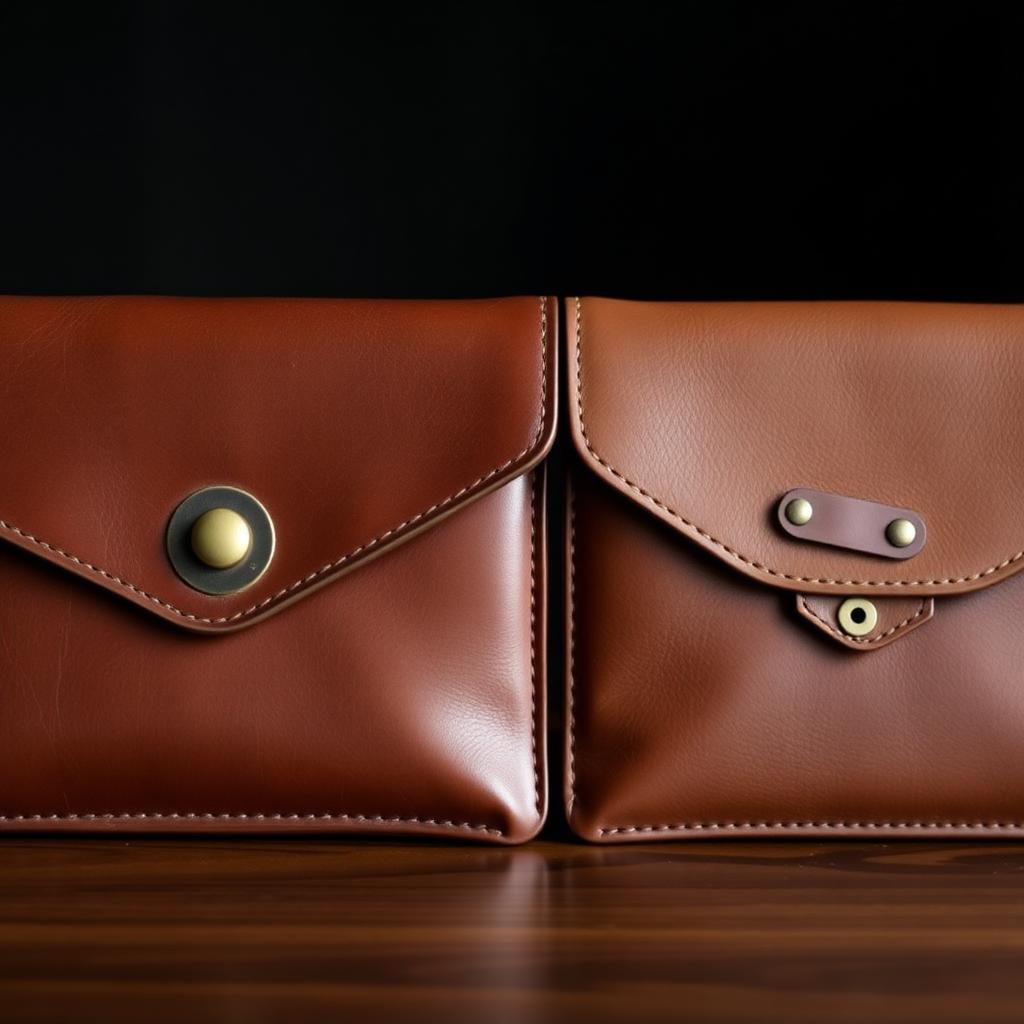
A round or shield-shaped brass housing set into the flap, with a spring-loaded button. Press the button, the flap releases. Close by pushing the flap down onto a mating pin set into the body. One-handed operation. Ubiquitous on 1970s and vintage-inspired clutches.
Tuck lock (strap lock)
A leather tab extends from the flap, passes through a metal frame or loop on the body, and folds back on itself — usually secured by a smaller snap, magnet, or turn. The metal is decorative structure, not the mechanism. Two-handed operation. Classic on saddle-inspired and heritage clutches.
Head-to-head
| Attribute | Push lock | Tuck lock |
|---|---|---|
| One-handed use | Yes | No |
| Mechanism complexity | Spring + button | Purely mechanical |
| Failure mode | Spring can weaken over years | Leather tab stretches, needs replacement |
| Aesthetic | 70s / mod / dressy | Heritage / saddle / rustic |
| Leather weight needed | 2–3oz (housing is small) | 3–4oz (tab must not stretch) |
| Installation difficulty | Moderate (precise punching) | Easy (leather work only) |
When to choose a push lock
- Evening clutches where a customer opens the bag with one hand while holding a drink.
- Boutique dressy pieces that reference vintage YSL, Celine, or 1970s design.
- Where the closure is intended as a visible metal focal point.
When to choose a tuck lock
- Heritage and saddle-inspired designs where visible stitching and leather straps are the language.
- Bags where you want to eliminate mechanical parts that can eventually fail.
- Small-batch work where custom hardware costs are prohibitive — a tuck lock is essentially free.
Installation notes
Push locks require precise chisel work: two rectangular slots for the housing prongs on the flap, one round hole and two slots for the pin plate on the body. Measure twice — off-center push locks are the number-one reason handmade clutches look amateur. Reinforce both sides with a leather backing patch to spread load.
Tuck locks ride on the strength of the tab leather. Use firm veg-tan of at least 3oz; laminated construction (two 2oz layers glued grain-to-flesh) resists stretch better than a single thicker piece. Saddle stitch the tab, do not rivet — rivets tear out under repeat tension. See our saddle stitching tutorial.
Related closures worth considering
If you are torn between the two, look at magnetic snaps and turn locks — see our comparison of magnetic vs turn lock closures and kiss lock vs turn lock for adjacent options.
Key takeaways
- Push locks are one-handed, spring-driven, and read dressy/vintage.
- Tuck locks are two-handed, purely mechanical, and read heritage/rustic.
- Push lock installation demands precision; tuck lock demands strong leather.
- Match the closure to the design language, not the other way around.
See more closure hardware in our zippers, clasps and locks category.
Enjoyed this guide?
Browse more in Zippers, Clasps & Locks or share this article with another leather maker who'd find it useful.