Rectangle Rings vs Square Rings for Leather Belts & Straps
Rectangle and square rings look almost interchangeable in a supplier catalog. In practice, they behave very differently — one lets a strap lay flat and adjust smoothly, the other locks a strap at a right angle. Choosing wrong means the strap twists, folds, or hangs unbalanced.
The geometry difference
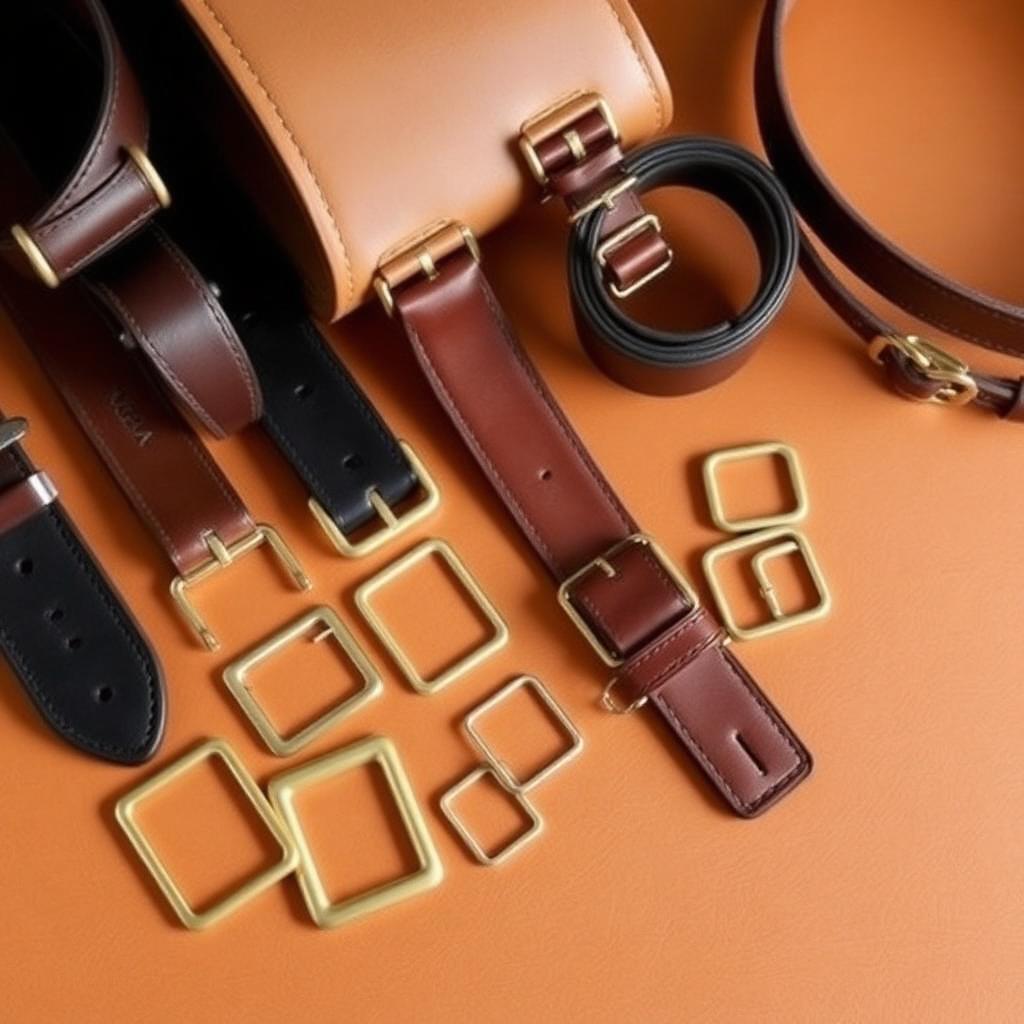
A rectangle ring is longer than it is wide. The strap threads through the long dimension, giving room to fold, adjust, and lay flat under a slide buckle. A square ring is equal on all sides. The strap enters and exits at the same width, making it a fixed 90° connector — no room for adjustment.
This distinction matters because it dictates whether the ring is a connector or an adjuster.
Head-to-head
| Property | Rectangle ring | Square ring |
|---|---|---|
| Primary role | Adjuster / slider anchor | Fixed 90° connector |
| Strap lay-flat behavior | Excellent | Locks strap perpendicular to body |
| Adjustable strap length | Yes — pair with slide buckle | No |
| Typical bag use | Adjustable shoulder strap ends | Rigid handle bases, gusset hardware |
| Typical belt use | Double-loop harness belts | Fashion belts, minimalist buckles |
| Wire diameter (25mm inside) | 4–5mm | 4–6mm |
Rectangle rings: the adjuster
The classic setup: strap → over slide buckle → through rectangle ring → back on itself. The rectangle's extra length gives the strap space to double without bunching. This is how nearly every messenger bag, camera strap, and adjustable crossbody bag is built. Pair with our guide to slide vs roller buckles for the full adjuster system.
The double-loop harness belt is another rectangle-ring signature. Two rectangle rings sit side by side; the belt threads through both, wraps back through one, and cinches. No buckle needed. Rectangle geometry is what makes it lay flat instead of buckling.
Square rings: the anchor
Square rings shine where you want a strap to exit a bag at a fixed 90° with no ability to twist or adjust. Common uses:
- Handle bases on totes where the handle must stand vertical.
- Gusset connectors where two panels meet at a right angle.
- Fashion belts where the "buckle" is really a decorative ring the strap tucks through.
- Minimalist bag closures where the strap simply wraps a square ring to keep the flap shut.
Where people get it wrong
- Using a square ring as a slide anchor. The strap has no room to double, so it bunches. Always rectangle for adjusters.
- Using a rectangle where you need a fixed angle. The strap will twist toward the long axis. Handles that should stand up flop sideways.
- Under-sizing wire diameter. On load-bearing straps, do not go below 4mm brass or 3mm stainless. See our D-ring sizing guide for load calculations that apply the same way.
Compare to other rings
For a full geometry breakdown across D, O, and rectangle rings, see our D vs O vs rectangle rings guide. For material and construction quality, see cast vs forged vs stamped rings — the same manufacturing rules apply.
Key takeaways
- Rectangle = adjuster. Long axis gives the strap room to double under a slide buckle.
- Square = fixed 90° anchor. Locks strap perpendicular to the body panel.
- Never substitute one for the other — the strap behavior is fundamentally different.
- Solid brass or stainless steel, 4mm+ wire on load-bearing straps.
Explore more connector geometry in our D-rings, hooks and connectors category.
Enjoyed this guide?
Browse more in D-Rings, Hooks & Connectors or share this article with another leather maker who'd find it useful.