How to Set Eyelets and Grommets in Leather Without Cracking Them
Eyelets and grommets reinforce holes that would otherwise stretch — lacing lines, drawstring channels, belt keeper slots, luggage tag punches. When they fail it is almost never the hardware's fault: the hole was wrong, the leather was too thin, or the die crushed the barrel instead of rolling it.
Eyelet vs grommet: not the same part
| Eyelet | Grommet | |
|---|---|---|
| Parts | One piece, or eyelet + washer | Two pieces: grommet + washer ring |
| Leather thickness | 0.8–2.0 mm | 1.5–4.0 mm |
| Strength | Light to medium | High — spreads load both faces |
| Typical use | Lacing, tags, small vents | Drawstrings, straps, curtain-style holes |
| Appearance | Slim, low profile | Chunkier, visible ring on the back |
Choosing size and material
- Barrel length must exceed total leather thickness by 1.5–2 mm to roll properly.
- Solid brass or stainless for anything exposed to moisture; plated steel corrodes at the cut edge.
- Match finish to existing hardware — see our guide to antique vs polished brass.
- #00 to #2 covers most small leather goods; #2–#4 for bags and drawstrings.
Step-by-step setting process
- Punch the exact hole. The hole must equal the barrel diameter — no clearance. Too big and the eyelet spins; too small and the flange splits as the barrel forces through.
- Reinforce thin leather. Under 1.2 mm, glue a second layer or a fabric interfacing patch behind the hole.
- Insert from the show face so the smooth flange faces outward and the rolled edge lands inside.
- Add the washer (grommets always; eyelets when the set includes one) with its concave side toward the leather.
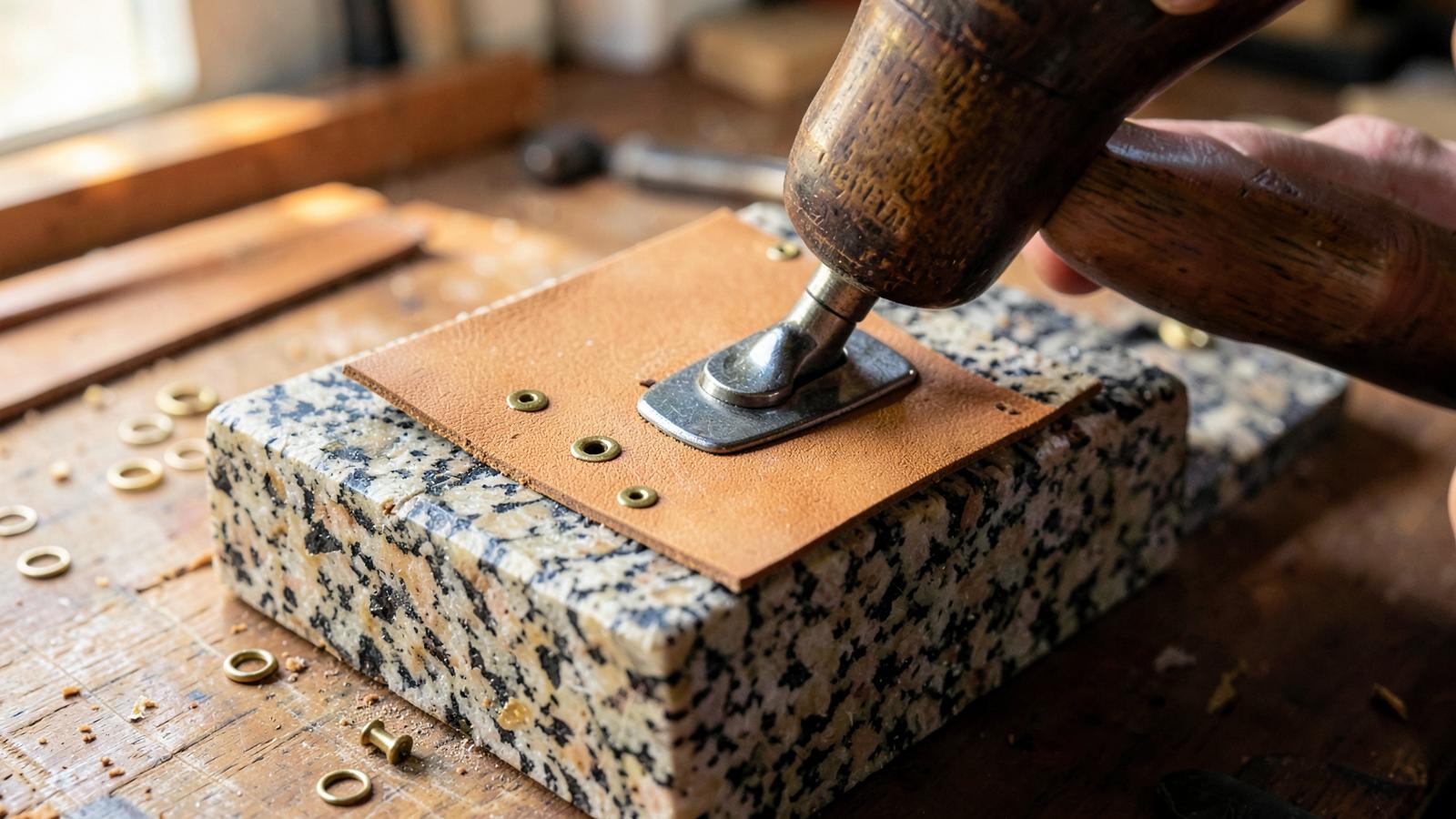
- Support on a hard block. Granite or steel. A cutting mat absorbs energy and produces a half-rolled barrel.
- Set with progressive taps, not one heavy blow: 5–8 medium mallet strikes let the barrel roll evenly. A hand press does this in one controlled stroke.
- Inspect. The rolled edge should look like a continuous curl. Cracks or petal-shaped splits mean the barrel was too short or the die mismatched.
Press vs mallet and die
| Mallet + die set | Hand press | |
|---|---|---|
| Cost | Low | Medium-high |
| Consistency | Depends on technique | Very high |
| Speed | Slower | Fast, repeatable |
| Best for | Occasional work, prototypes | Production runs, lacing lines |
If you set more than a dozen eyelets in a run, a press pays for itself in rejects avoided — the same logic covered in installing snaps without a press.
Troubleshooting
| Symptom | Cause | Fix |
|---|---|---|
| Flange split into petals | Barrel too short or blow too hard | Longer barrel, lighter progressive taps |
| Eyelet spins freely | Hole oversized | Punch exactly to barrel diameter |
| Barrel folded sideways | Die not centred / soft surface | Centre die, work on granite |
| Leather puckers around hole | Too thin, unreinforced | Add backing layer |
| Grommet pulls out under load | Washer omitted or reversed | Always fit washer, concave to leather |
Key takeaways
- Hole diameter equals barrel diameter — exactly.
- Barrel length = leather thickness + 1.5–2 mm.
- Hard block, centred die, progressive taps.
- Grommets for load-bearing holes; eyelets for light decorative work.
FAQ
Can I set eyelets with pliers?
Eyelet pliers work for #00–#0 in thin leather only. Above that they lack the throw to roll the barrel fully.
Do brass eyelets tarnish?
Unlacquered solid brass develops a patina; lacquered stays bright longer. Corrosion behaviour of copper alloys is documented by the Copper Development Association.
Which side does the washer go on?
The back — the non-show face — with the concave side facing the leather so the barrel curls into it.
Conclusion
Exact holes, adequate barrel length and a hard surface turn eyelet setting from a gamble into a routine. Keep building skills in Leathercraft Guides & Tutorials.
Enjoyed this guide?
Browse more in Leathercraft Guides & Tutorials or share this article with another leather maker who'd find it useful.