How to Replace a Leather Bag Strap: Measure, Match Hooks and Fit
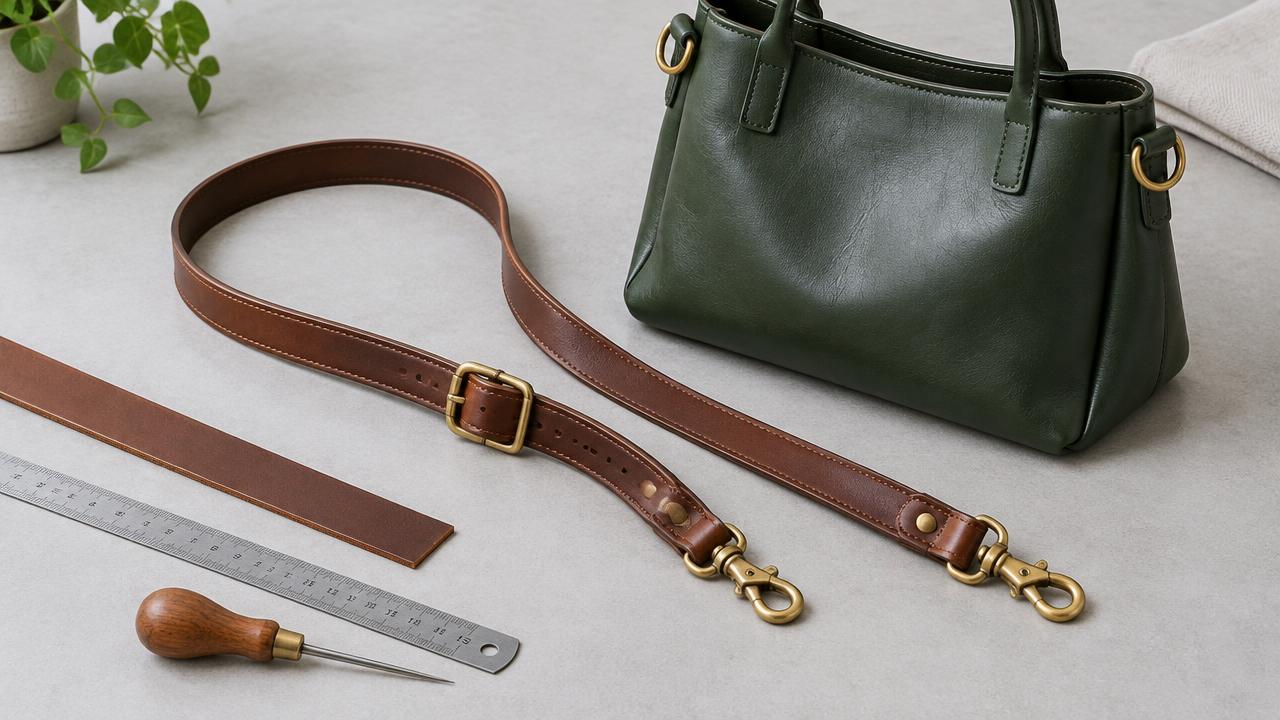
Replacing a detachable leather bag strap is usually straightforward: measure the comfortable length between the bag's attachment points, match the hooks to its rings, and secure the new strap ends with properly reinforced folds. The difficult part is recognising when a worn bag anchor—not the strap—is the actual problem.
This guide is for ordinary handbags and small everyday bags with accessible attachment rings. It does not establish a load rating and is not suitable for safety equipment, climbing gear or other load-critical uses. The photograph is an illustrative replacement design.
Inspect the bag before buying a strap
Open both existing hooks and inspect the bag rings, anchor tabs and surrounding seams. Look for sharp burrs, distorted rings, cracked leather, stretched holes or stitches pulling through. A new strap will not repair a weak anchor. If the attachment disappears under a lining, consult a leather repairer rather than cutting into the bag blindly.
If the anchor needs rebuilding, start with our strap anchor reinforcement guide. A visibly opened ring or hook gate that no longer closes fully should be replaced, not squeezed back and assumed safe.
Measure length the way the bag is worn
- Set the old strap to a comfortable length, if it still exists.
- Measure the complete strap from the bearing point inside one hook to the equivalent point in the other. This includes the hooks; it is not just leather length.
- If there is no usable old strap, run a piece of cord between the bag rings and over the wearer in the desired position.
- Try the measurement with the clothing normally worn with the bag. Allow adjustment for coats and shoulder versus crossbody use.
Do not pick a universal crossbody length from a chart. Body proportions, ring placement and bag height determine where the bag rests. For a fixed strap, subtract the two hooks' effective lengths from the finished hook-to-hook length, then add the material consumed by the end folds. Mock up those folds around the actual hardware before cutting.
Match hooks, rings and strap width
| Dimension | What it controls | Check before buying |
|---|---|---|
| Hook attachment bar width | Width of leather entering the hook | Strap fits without bunching or sliding excessively |
| Hook throat opening | Whether the bag ring enters | Clearance around the ring's wire thickness |
| Hook body and swivel clearance | Freedom to rotate | No binding against the bag or ring |
| Buckle internal width | Adjustment section width | Matches the actual strap, not buckle exterior width |
For example, a nominal 20 mm strap bar says nothing about whether the hook gate clears a thick ring. Bring the bag or accurate ring measurements to the hardware purchase. Compare swivel and trigger hooks and D-ring construction, but do not infer load capacity from appearance or alloy alone.
Choose a replacement construction
| Construction | Useful when | Main precaution |
|---|---|---|
| Ready-made adjustable strap | You want a direct detachable replacement | Verify the full length range and hook fit |
| Single firm leather strip | You want a simple fixed-length strap | Check stretch, underside comfort and edge finish |
| Stitched two-layer leather | You need a finished underside | Choose hardware for the combined thickness |
| Webbing with leather ends | You prefer a wider flexible shoulder section | Use an established reinforcement pattern at the transitions |
Leather thickness is not a load rating. Firmness, hide quality, width, stitching and the condition of every connection matter. For a homemade everyday strap, begin with a sound, firm strap leather and follow a known strap construction rather than cutting a soft fashion leather offcut.
Assemble a simple fixed-length leather strap
- Make a full-size mock-up. Mark the finished bearing-to-bearing length and the folds around both actual hook bars. Confirm the bag's position on the wearer.
- Cut the strip consistently. Use a straight edge or strap cutter. Avoid defects at attachment folds and finish the edges before closing them. Our belt-making guide covers straight cutting and end shaping.
- Prepare the folds. Fold the leather around the hook bars without trapping the swivel. If thinning is needed, use controlled skiving and avoid weakening the bending point.
- Secure each return. Use an established stitched strap-end pattern with adequate overlap, or correctly sized removable fasteners in an appropriate reinforced layout. Do not copy a decorative single-rivet attachment and assume it will carry your bag.
- Match fastener grip. Measure the compressed leather stack. Choose screw or rivet length from its supplier's specification. Our Chicago screws versus rivets guide explains serviceability; follow the maker's instructions for tightening and any thread-locking product.
- Inspect the result. Clip both ends to the bag, check that gates return closed and confirm the strap lays flat. Test with the intended everyday contents over a soft surface, inspecting again for movement or damage.
Adding buckle adjustment
An adjustable strap needs a different pattern: a buckle section, a perforated section and a keeper. Follow the buckle maker's fitting dimensions and plan the adjustment range before punching. Avoid adding holes near the end fold or making an overlong slot that leaves little leather around the buckle tongue.
For sizing and layout, see our step-by-step belt tutorial. A friction slide adjuster needs leather thin and flexible enough for its slots; it is not a direct substitute for every buckle.
Frequently asked questions
Can I replace a permanently sewn-in strap myself?
Sometimes, but the work may require opening the lining and reconstructing an anchor. This detachable-strap tutorial does not cover that repair. A repairer is the safer choice when the bag structure is hidden.
Why does my replacement hook stick on the D-ring?
The throat, swivel or body may be too small for the ring. Replace the hook with a compatible one; filing structural metal or holding the gate partly open is not a sound fix.
How often should I check Chicago screws?
Inspect them after initial use and regularly thereafter, particularly if the strap twists or is detached often. There is no universal interval; follow the fastener maker's advice and stop using a connection that loosens.
Further reading
Andrie Designs’ swivel hook tutorial illustrates the fold-through attachment sequence on a sewn fabric strap. Use it for the hardware orientation, not as a load specification for leather.
Keep the repair serviceable
A good replacement strap fits the wearer and the original rings without forcing either. Keep the hardware specifications for future repairs and browse Leathercraft Guides & Tutorials for stitching, edge finishing and reinforcement techniques.
Printable project checklist
How to Replace a Leather Bag Strap: Measure, Match Hooks and Fit
Materials and tools checklist
Step-by-step checklist
Assembly steps cover a fixed-length detachable strap for ordinary everyday bags, not permanently sewn-in straps or load-critical equipment. A new strap cannot repair a weak bag anchor. An adjustable version requires a different pattern.
Enjoyed this guide?
Browse more in Leathercraft Guides & Tutorials or share this article with another leather maker who'd find it useful.