How to Install a Turn Lock on a Leather Bag (Twist Lock Tutorial)
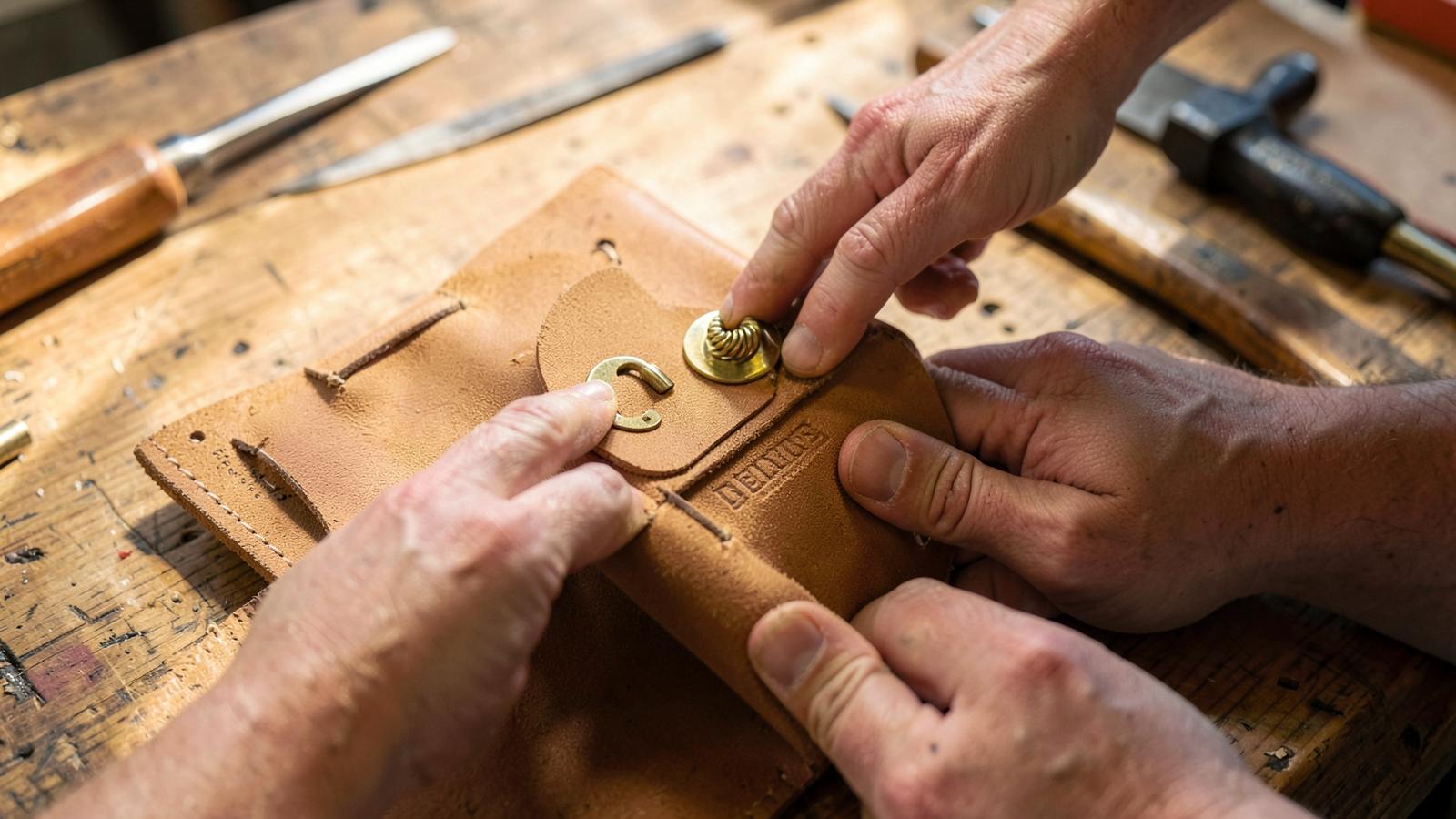
Turn locks — twist locks, rotating clasps, whatever your supplier calls them — are two-part hardware: a rotating tongue on the bag body and a plate with a slotted window on the flap. Because both halves are visible, the install is judged on alignment above everything. Get the layout right and the rest is mechanical.
Anatomy of a turn lock set
| Part | Goes on | Fixing |
|---|---|---|
| Rotating tongue / knob | Bag body panel | Two prongs or two machine screws |
| Base washer | Inside of body panel | Prongs folded over it |
| Flap plate (slotted window) | Underside of flap | Prongs or screws through the flap |
| Backing washer | Show face of flap | Sandwiches the flap leather |
Tools
- Slot punch 2 x 8 mm and a 3 mm round punch
- Sharp swivel knife or #11 blade for the plate window
- Steel ruler, wing divider, silver marking pen
- Mallet, poly cutting board, taped pliers
- 1.2–1.5 mm veg-tan for reinforcement tabs
Step 1 — Build the bag dry and mark from the fold
Assemble the body and gussets, fold the flap into its closed position and hold it with clips. Mark the tongue centre through the flap with an awl. Never measure the two halves independently from panel edges — flaps shift once gussets are sewn, and the error becomes permanent.
Step 2 — Reinforce both positions
Glue a 40 x 40 mm reinforcement patch behind the tongue position and behind the flap plate. The flap plate especially concentrates load along the window edges; unreinforced 1.4 mm leather stretches into a visible bulge within a season. The same rule applies to every load-bearing closure, as covered in reinforcing strap anchors.
Step 3 — Cut the flap window
Trace the plate's inner window with a silver pen, then remove the waste with a round punch at each end and straight knife cuts between. Cut 0.5 mm smaller than traced and pare to fit — an oversize window shows a gap around the plate and cannot be corrected.
Step 4 — Fit the tongue to the body
Punch two slots for the prongs, insert, seat the base washer inside, then fold the prongs outward, away from each other. Outward folds distribute stress across the washer instead of tearing the narrow strip between slots. On thick veg-tan use a screw-back turn lock instead — prongs will not fold cleanly through 4 mm.
Step 5 — Fit the flap plate and test rotation
Set the plate, sandwich the flap with the backing washer, fix, then close the bag and rotate the tongue 90°. The tongue should turn with light finger pressure and no lift in the flap. If it binds, the window is 1 mm too far forward — the reason step 1 matters.
Prong vs screw fixing
| Prong fixing | Screw fixing | |
|---|---|---|
| Leather thickness | 0.8–2.0 mm | 1.5–4.5 mm |
| Serviceable | No | Yes — can be removed |
| Strength | Good with washer | Excellent |
| Best for | Lined soft bags | Structured veg-tan bags, briefcases |
If you are still choosing a closure style, compare magnetic closures vs turn locks and push locks vs tuck locks first.
Key takeaways
- Mark the flap from the folded, assembled bag — never from edges.
- Reinforce behind both halves before cutting anything.
- Cut the window undersize and pare to fit.
- Screw-back sets for leather above 2 mm.
FAQ
My turn lock is stiff to rotate. Why?
Either the window sits too far from the fold, putting the tongue under tension, or the flap is thicker than the plate's clearance. Skive the flap under the plate by 0.3 mm.
Can I install a turn lock after lining?
No. Both halves need access to the back face. Fit hardware, then close the lining.
Is solid brass worth it for a turn lock?
Yes — the tongue is a wear surface. Plated zinc rubs through at the pivot. See our comparison of solid brass vs plated hardware and industry material standards from ASTM International.
Conclusion
Turn locks reward patient layout more than any other bag component. Take the extra ten minutes on marking. More installs in Leathercraft Guides & Tutorials.
Enjoyed this guide?
Browse more in Leathercraft Guides & Tutorials or share this article with another leather maker who'd find it useful.